


Transrotor and in-akustik: Tonearm Cabling with AIR Technology
"I don’t expect to hear any difference." That was Dirk Räke of Transrotor’s expectation going into the listening test. The result surprised him: "The difference was clearly audible."
What to Expect from This Article
How did the renowned turntable manufacturer Transrotor come to equip its TRA 9 tonearm with in-akustik’s AIR Technology? What role does the tonearm cable play in transmitting the extremely delicate signal from an MM or MC cartridge? And why is AIR Technology particularly well suited to this demanding application?
In this blog article, we take a look behind the scenes of the collaboration. We explain the importance of tonearm cabling in the analog signal chain, why capacitance and shielding are particularly important when handling phono signals, and how AIR Technology addresses these challenges through its air dielectric and unique conductor geometry.
And, of course, we get to the crucial question: What did Dirk Räke hear during the listening test that surprised him himself? In the interview, the Transrotor Managing Director talks about how the collaboration came about, the requirements for high-quality tonearm cabling, and his personal experience with AIR Technology. The images show the TRA 9 fitted with the in-akustik AIR Pure Silver tonearm cable.


How Transrotor and in-akustik Came Together
Transrotor and in-akustik share a similar approach: not only developing technical solutions, but refining them down to the smallest detail.
A few years ago, Transrotor began developing its own line of tonearms. The company builds on a proven mechanical design and continuously refines it. The tonearm uses a classic gimbal bearing system with high-precision Japanese ball bearings, which are individually selected and adjusted. The manufacturing process is equally focused on precision. Design and machining of the components are carried out in-house at Transrotor.
in-akustik’s AIR Technology addresses a different part of the analog signal chain: the electrical connection between the cartridge and the phono preamplifier. It therefore made sense to bring the two approaches together.
A Tonearm Directly Connected to the in-akustik AIR Cable
For this joint solution, the Transrotor tonearm is wired directly with the in-akustik Reference AIR Pure Silver. The connection doesn't begin at a socket. Instead, the AIR wiring is integrated directly into the tonearm and runs all the way through to the external connectors. This creates a continuous, unbroken signal path with no additional plug connection inside the tonearm itself. To achieve this, the tonearm is sent to in-akustik, where it is fitted with the special AIR wiring by hand. This AIR wiring isn't limited to new orders: existing Transrotor tonearms can also be retrofitted with the AIR technology in the same way.
The continuous wiring and the elaborate AIR construction aren't an end in themselves. Their purpose is to carry the exceptionally delicate phono signal to the phono preamp with as little noise interference and added load as possible.
A phono cartridge produces a very low-level electrical signal that must reach the phono preamplifier with as little interference as possible before being amplified. MC cartridges in particular often have output voltages of just a few hundred microvolts.
The tonearm cable connects the tonearm to the phono preamplifier. In addition to transmitting the signal, effective shielding, a well-defined ground connection and stress-free cable routing are important factors.
Cable length also matters: the cable must provide sufficient flexibility for practical positioning and routing, but should not be longer than necessary. As cable length increases, its electrical parameters, such as capacitance and inductance, also increase, while maintaining sufficient distance from potential sources of interference becomes more difficult.
With MM cartridges, the total capacitance of the connection can also affect the frequency response. With MC cartridges, this effect is generally less pronounced. In both cases, however, a carefully designed and properly shielded connection remains crucial.
A cable’s capacitance depends, among other factors, on the geometry of its conductors and the dielectric material used. When two conductors are positioned closer together, their capacitive coupling increases. Conversely, capacitance can be reduced by keeping the conductors farther apart and minimizing the amount of insulating material between them.
This is precisely where AIR Technology comes into play.
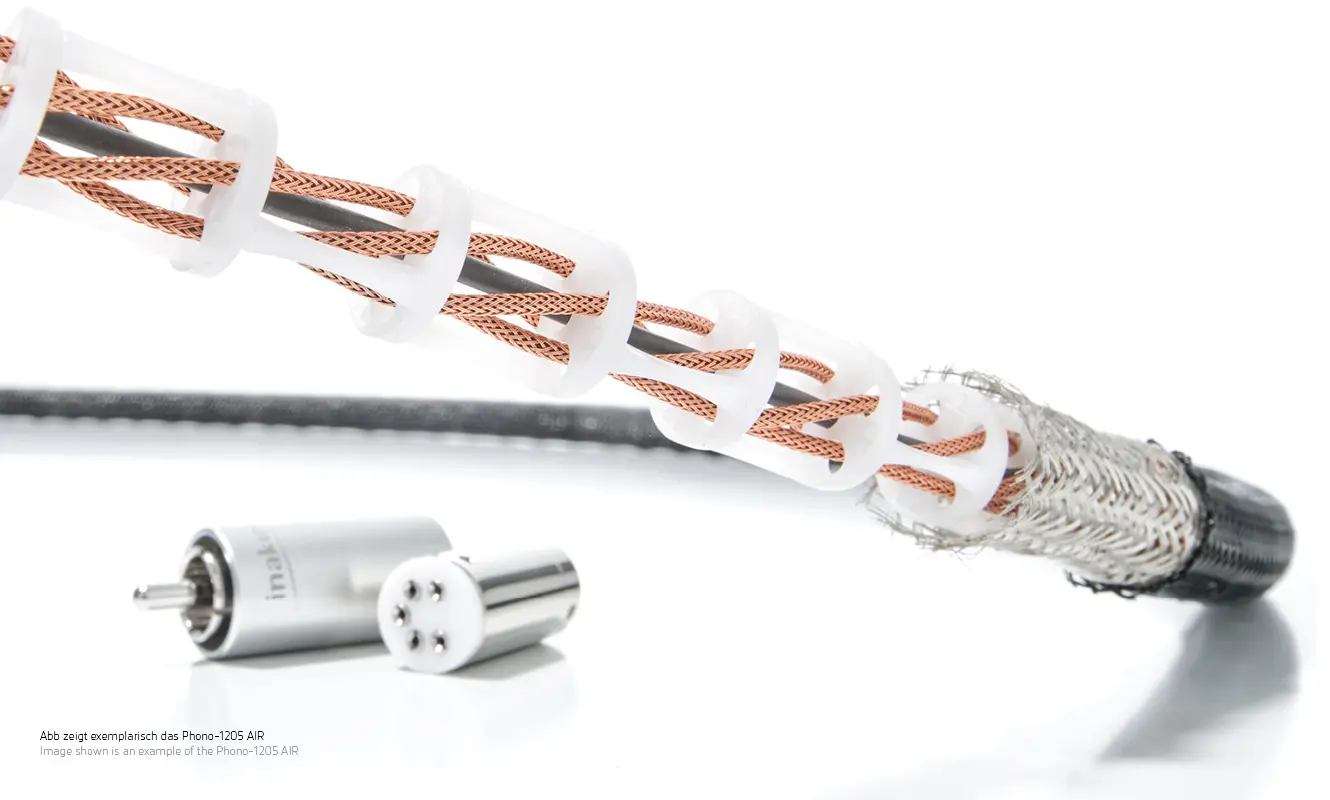
In the AIR design, the conductors are routed at a defined distance from each other and held in position by a special structure. Air takes over a significant part of the function of the dielectric. The result is exceptionally low capacitance. At the same time, the defined geometry ensures that the distance between the conductors remains as consistent as possible along the entire length of the cable.
AIR does not simply mean that a cable uses air as an insulating material. What matters is the overall geometry: the conductors are routed at a defined distance from each other and held in place by a special AIR structure. This allows the electrical environment surrounding the conductors to be precisely controlled.
The implementation is complex. The fine conductors are threaded by hand into the AIR Helix. This step cannot simply be carried out using conventional machine production. It is precisely this combination of defined conductor geometry, air as the primary dielectric, and manual manufacturing that is a key characteristic of AIR Technology.
For sensitive phono applications, this results in a cable design that allows capacitance to be kept exceptionally low.
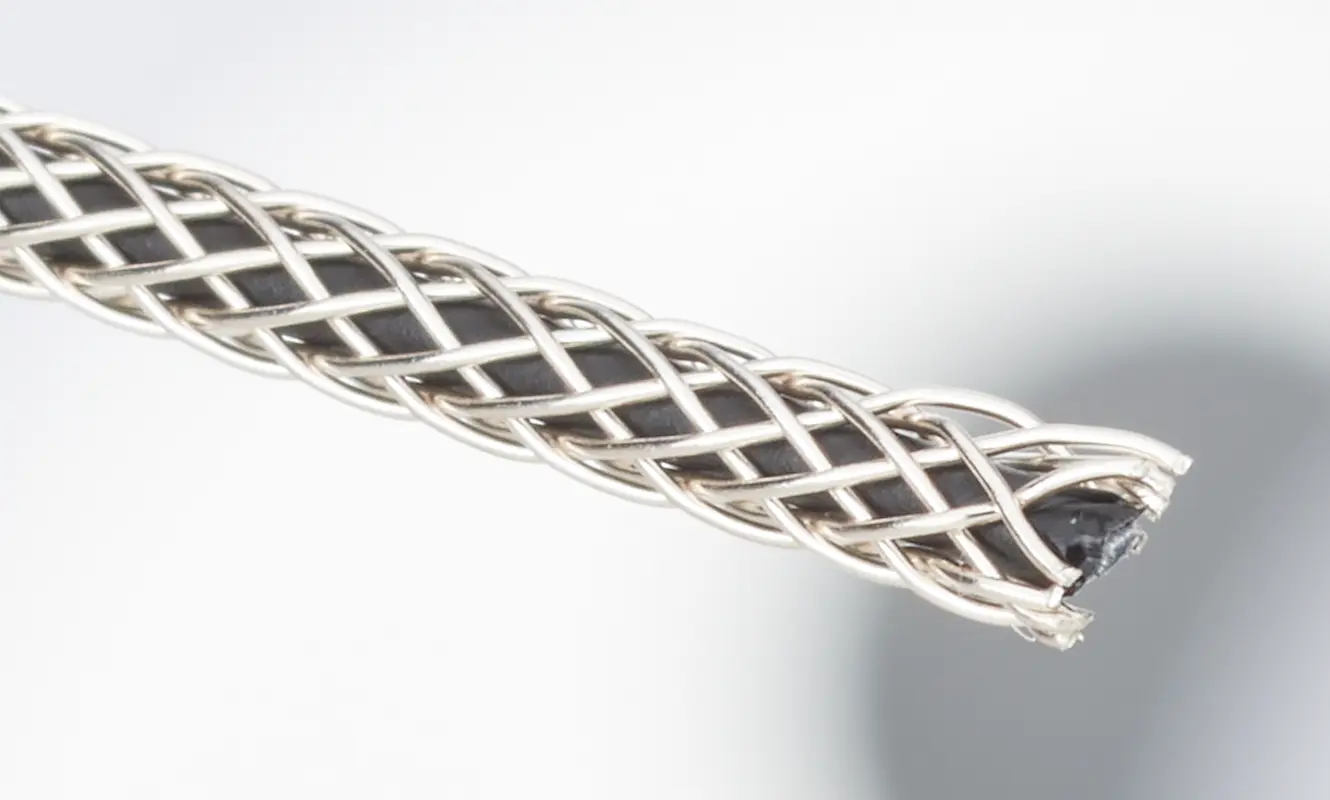
The Transrotor solution uses high-purity pure silver conductors. At room temperature, silver has the highest electrical conductivity of any metal, making it an excellent choice for transmitting the extremely low-level phono signal.
These are not silver-plated conductors, where silver is used merely as a surface layer over another material. In the Reference AIR Pure Silver, the signal conductors themselves are made of high-purity silver – continuously from the cartridge through the tonearm to the cable connection.
However, the conductor material alone is not the decisive factor. Pure silver conductors, defined AIR geometry, air-based insulation and sophisticated shielding work together as a complete system, providing a direct, low-capacitance and interference-resistant signal path.
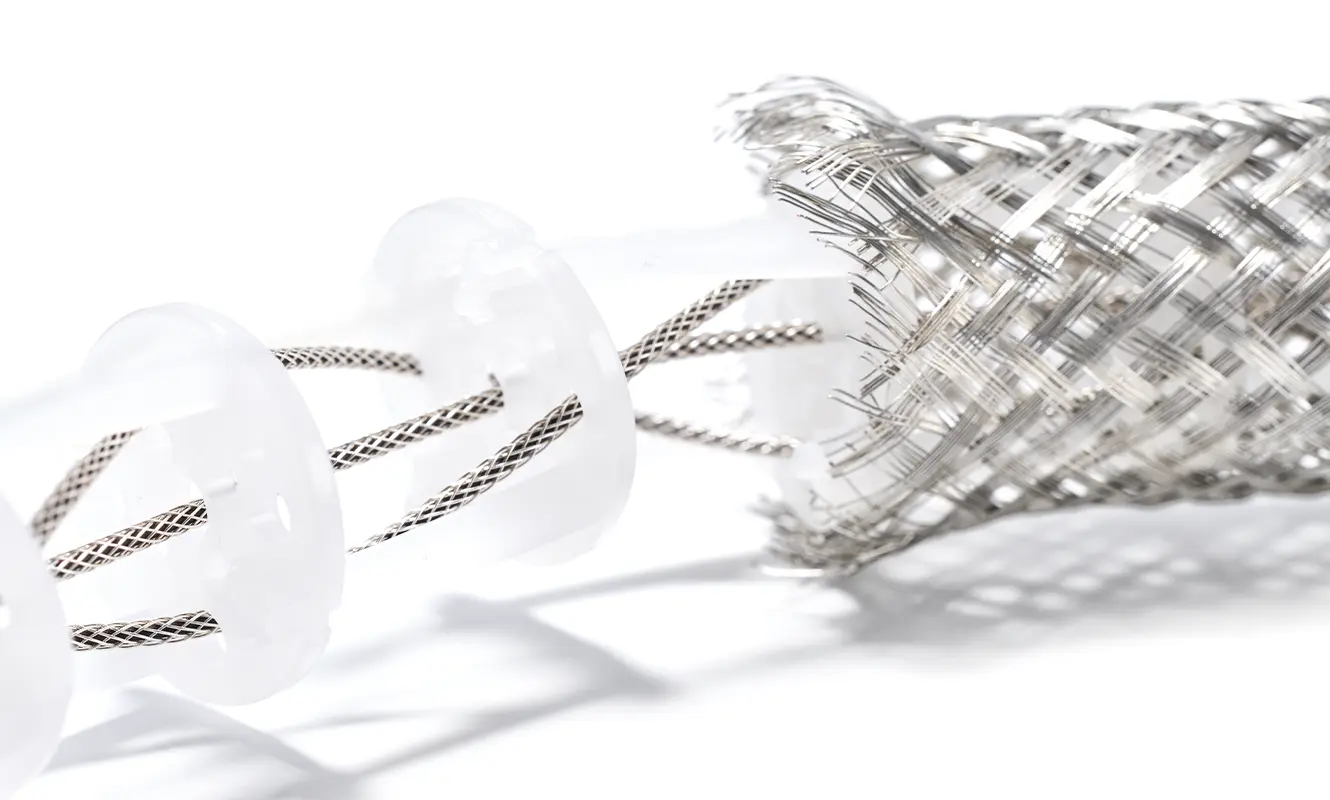
In addition to capacitance, shielding is a key element of a carefully designed phono connection. A cartridge produces a signal in the millivolt range, which is then heavily amplified by the phono preamplifier. As a result, even low levels of electromagnetic interference can become audible. Potential sources of interference include power cables, transformers, amplifiers, switch-mode power supplies and wireless devices, all of which can be found around a HiFi system and therefore in close proximity to the phono cabling.
Effective shielding reduces the coupling of such interference into the signal path. It is not only the shield itself that matters, but also its continuous implementation, grounding, cable routing and the specific environment in which the equipment is installed.
With the AIR cabling, the shielding is therefore extended right into the area of the solder joints. The aim is to provide continuous shielding along the sensitive signal path – from the tonearm all the way to the connections of the phono preamplifier.


Precision Doesn’t End at the Tonearm
The collaboration between Transrotor and in-akustik is based on a shared philosophy: when the individual components of an analog playback chain are designed for precision, the connection between them should be engineered to the same exacting standards.
For Transrotor, this means the precise mechanical guidance of the cartridge. For in-akustik, it means the accurate electrical transmission of the resulting signal. Integrating the AIR cabling directly into the tonearm brings these two approaches together.
Handcrafted for a Special Connection
Directly wiring a tonearm is not a conventional cable assembly. The fine conductors have to be routed through the tonearm and then integrated into the AIR structure. Shielding, connectors and other components are assembled by hand and carefully tested.
This level of craftsmanship is necessary to implement the design characteristics of AIR Technology within the tonearm itself. The result is a connection individually tailored to the tonearm – from the cartridge all the way to the external connection.
-

Two Manufactories. One Standard.
Handcrafted Down to the Finest Detail
-

Every Tonearm Is Handcrafted
Precision You Can Hear
"The Difference Was Clearly Audible"
Technical considerations were the starting point, but the listening test proved decisive. Dirk Räke of Transrotor approached the comparison with a deliberately skeptical mindset. In the following interview, he explains how the collaboration with in-akustik came about and why AIR Technology ultimately convinced him.
Mr. Räke, Transrotor is best known for its turntables. Why did the company decide to develop its own tonearms as well?
We have worked with different tonearms and tonearm designs for many years. In the process, we gained a great deal of experience – with what works, with what we like, but also with what we would do differently. A few years ago, we therefore decided to take development into our own hands.
Our approach was never to develop an exotic concept at any cost. We prefer proven mechanical principles and refine them to what we consider the optimum through a great deal of attention to detail. That is why the TRA 9 uses a classic two-axis gimbal bearing system with high-precision Japanese ball bearings. These are individually selected and carefully adjusted to ensure that the tonearm moves freely while being guided securely and precisely.
How important is the cabling in such a precisely engineered tonearm design?
Very important. The cartridge generates an extremely small and sensitive signal. That is why the signal path from the cartridge to the phono preamplifier should be implemented as consistently and with as little interference as possible. For us, it was crucial not to regard the cabling as an add-on, but as an integral part of the overall tonearm design. The mechanical precision of the tonearm and the quality of the electrical signal transmission go hand in hand.

How did the collaboration with in-akustik come about?
We had, of course, been familiar with in-akustik and AIR Technology for some time. At some point, the idea emerged to take a closer look at the tonearm cabling. With a phono signal in particular, we are dealing with a very low-level and therefore sensitive signal. Factors such as the cable’s electrical characteristics, capacitance, inductance and, above all, shielding play an important role. We therefore wanted to find out what could be achieved by consistently tailoring the cabling to this particular application.
What particularly convinced you about AIR Technology?
It is not simply a matter of using air as a dielectric somewhere in the cable. What matters is the overall construction: the geometry, the way the conductors are routed and, above all, the defined, consistent distance between the conductors along the entire length. We visited in-akustik to see the manufacturing process for ourselves. That is when you really understand the effort involved. This structure is assembled by hand because it cannot simply be produced using a conventional machine. We found this consistency in both the design and the manufacturing process particularly convincing.
You subsequently listened to the new cabling yourself. What were your expectations going into the listening test?
I am generally very critical when it comes to listening tests like this, and I went into it with the mindset: “I’m not going to hear any difference.” After all, I was already completely satisfied with the existing tonearm. It sounded excellent. There was no obvious shortcoming that we needed to address.
And what did you actually hear?
There was a very clear difference. I had the impression that there was an even greater sense of calm. At the same time, the setup seemed to be less susceptible to external sources of interference. You could move a source of interference past it without anything happening. That surprised me because I had not initially expected to hear a difference at all. After that, it was actually clear to us that we wanted to continue the collaboration.
What makes this collaboration special for you?
With a tonearm, it is about precision in the mechanics. With the cable, it is about precision in the electrical signal path. These are different areas, but the underlying approach is similar: you look at every detail and consistently try to minimize unnecessary influences. When two companies share this level of commitment, the result is a collaboration that does not feel contrived, but makes technical sense.
FAQ: Tonearm Cables
Tonearm wiring refers, first and foremost, to the fine conductors inside the tonearm that carry the signal from the cartridge to the tonearm output. This is normally followed by a separate phono cable, which connects the tonearm to the phono preamplifier or the phono input of an amplifier.
In general usage, however, the term “tonearm cable” is also often used to describe the complete connection, including both the internal tonearm wiring and the external phono cable. Depending on the turntable design, these two sections may be constructed differently. In some designs, the connection from the cartridge all the way to the phono preamplifier is implemented as a continuous cable run.
A tonearm cable or phono connection typically carries a much lower-level signal than the connection between a CD player, streamer or DAC and an amplifier. Depending on the cartridge, the output is in the millivolt range and is subsequently amplified significantly by the phono preamplifier.
For this reason, capacitance, shielding, grounding, cable length, and the mechanical and electrical quality of the connectors are particularly important in phono connections.
Capacitance is an electrical property of a cable. It is influenced, among other factors, by the distance between the conductors, conductor geometry, insulation material and cable length.
With MM cartridges in particular, the combined capacitance of the tonearm wiring, phono cable and phono input forms a relevant electrical configuration together with the inductance of the cartridge. Excessive or improperly matched total capacitance can affect the frequency response. This is why many manufacturers specify a recommended range for the load capacitance of their MM cartridges.
With MC cartridges, cable capacitance is generally less critical than with MM cartridges due to the significantly lower inductance of the cartridge. Nevertheless, careful signal routing, an appropriate load impedance and effective shielding remain important aspects of the phono connection.
A tonearm cable should not be unnecessarily long, while still providing sufficient slack for stress-free routing. As cable length increases, capacitance generally increases as well. In addition, it can become more difficult to maintain sufficient distance from potential sources of interference.
It is important to route the cable without mechanical stress, avoiding sharp bends or tension on the tonearm. Keeping the cable as far away as possible from mains cables, transformers, power supplies and other electrical equipment is advisable. If audio and mains cables cannot be routed separately, they should ideally cross only briefly and as close to a right angle as possible, rather than running parallel over longer distances.
If a greater distance to the amplifier needs to be bridged, it may be beneficial to position the phono preamplifier closer to the turntable and use the longer cable run only downstream of the phono preamplifier.
The signal from a phono cartridge is very low in level and is heavily amplified by the phono preamplifier. Depending on grounding, equipment placement, cable routing and the surrounding electromagnetic environment, external interference can therefore become significant.
Shielding is intended to reduce the pickup of such interference as much as possible. Typical potential sources of interference include mains cables, transformers, switch-mode power supplies, amplifiers and wireless devices. Proper grounding and sensible cable routing are just as important as the shielding itself.
On many turntables, a separate ground wire provides a defined electrical connection between metal components of the turntable – such as the chassis or tonearm – and the ground terminal on the phono preamplifier or amplifier. It can help reduce potential differences and, as a result, unwanted hum or interference.
Whether a separate ground wire is required, where it should be connected and which components are connected through it depends on the design of the turntable, tonearm and phono preamplifier. The manufacturer’s connection instructions should therefore always take precedence. If hum occurs, the ground connection, connectors and cable routing are among the first things that should be checked.
RCA connectors are widely used with turntables and phono preamplifiers. Depending on the tonearm, turntable and phono preamplifier, however, DIN, XLR or manufacturer-specific connectors may also be used.
The connector type itself is not the only factor that matters. What is essential is correct wiring and careful implementation: proper grounding, effective shielding, reliable contact and adequate mechanical strain relief for the cable.
Yes. The AIR wiring isn't limited to new orders - existing Transrotor tonearms can also be retrofitted with the in-akustik AIR technology. To do so, the tonearm is sent to in-akustik, where it's fitted with the wiring in the same way as on a new order. Price-wise, the retrofit matches the surcharge that also applies when ordering the AIR wiring on a new tonearm..


The good old record sounds more vibrant than ever. The demand is astonishing, even for experts. The figures for records sold are increasing just as surprisingly as the number of record players. It’s a real boom. But how to improve the sound? One way is to use a new, better cable between the tonearm and the phono amplifier. The Phono-1205 AIR is a cable created to deliver top sound. What sets it apart is an absolutely unique air insulation, called the Air Helix. We have developed a special clip for this technology. It separates the two cable bundles, keeps them apart, and virtually embeds them in air. Using a large number of these clips, it is possible to route earth and signal extremely stably over longer distances. Why the effort? With this approach it is possible to pass on the sensitive signals without slowing them down - the result is fast and high-resolution sound. The Super Speed waveguides are threaded by hand and the clips are fitted with great care in the company's own factory. After this, the resulting Air Helix is also shielded and fitted with the PE network jacket by hand. Finally, the rhodium-plated connectors are fitted and cable functionality is tested. Because it's all about the most important, smallest signals: There is nowhere in the audio world where smaller currents flow that need to be passed on perfectly. The signal level of an MM or MC system is extremely sensitive, at just a few thousandths of a volt. In addition to this, the systems have an inductive character. In combination with the cable capacitance, they form what is known as an oscillating circuit, which favors specific frequencies. If these frequencies are unfavorable due to excessively high capacitance, this has a major effect on the harmony of the sound. Extremely low capacitance and dielectric losses are just two advantages of the Referenz Phono -1205 AIR. They form the basis for unadulterated enjoyment of your vinyl jewels. The sound of good records can hardly be resolved in a finer way than this. Click here and discover the exciting details


The good old record sounds more vibrant than ever. The demand is astonishing, even for experts. The figures for records sold are increasing just as surprisingly as the number of record players. It’s a real boom. But how to improve the sound? One way is to use a new, better cable between the tonearm and the phono amplifier. The Phono-2405 AIR is a cable created to deliver top sound. What sets it apart is an absolutely unique air insulation, called the Air Helix. We have developed a special clip for this technology. It separates the two cable bundles, keeps them apart, and virtually embeds them in air. Using a large number of these clips, it is possible to route earth and signal extremely stably over longer distances. Why the effort? With this approach it is possible to pass on the sensitive signals without slowing them down - the result is fast and high-resolution sound. The Super Speed waveguides are threaded by hand and the clips are fitted with great care in the company's own factory. After this, the resulting Air Helix is also shielded and fitted with the PE network jacket by hand. Finally, the rhodium-plated connectors are fitted and cable functionality is tested. Because it's all about the most important, smallest signals: There is nowhere in the audio world where smaller currents flow that need to be passed on perfectly. The signal level of an MM or MC system is extremely sensitive, at just a few thousandths of a volt. In addition to this, the systems have an inductive character. In combination with the cable capacitance, they form what is known as an oscillating circuit, which favors specific frequencies. If these frequencies are unfavorable due to excessively high capacitance, this has a major effect on the harmony of the sound. Extremely low capacitance and dielectric losses are just two advantages of the Referenz Phono -2405 AIR. They form the basis for unadulterated enjoyment of your vinyl jewels. The sound of good records can hardly be resolved in a finer way than this. Click here and discover the exciting details


Phono signals are among the most delicate signals in the entire hi-fi chain: The output levels of MM and MC systems are in the millivolt and microvolt range, respectively — and are correspondingly sensitive to any interference in the signal path. The S25 phono cable is designed precisely for this requirement: It transmits these delicate signals with neutral sound and technical precision—from the record player to the phono stage, without loss, without coloration, and without compromise. At the heart of the S25 phono cable are signal conductors made of high-purity, oxygen-free copper (OFC), insulated with foamed polyethylene—a dielectric with a particularly low dielectric constant for low-loss signal transmission. The balanced dual-mono structure carries the positive and negative signals via separate conductors—this reduces crossover interference and ensures stable, low-noise signal transmission from the record player to the phono preamp. A dense shielding braid made of 186 fine copper wires protects against external interference sources such as Wi-Fi or Bluetooth devices. A separate ground wire reliably dissipates any remaining interference from the record player—for a quiet, hum-free soundstage. The gold-plated solid-metal connectors ensure consistently reliable contact with low contact resistance and high mechanical stability. The highly flexible construction and understated design blend seamlessly into any existing system. Like all cables in the S25 series, the phono cable is manufactured entirely in our cable factory in Ballrechten-Dottingen—assembled by hand and individually tested for flawless signal transmission. Made in Germany. No frills. Just clean engineering. Click here to discover exciting details

Transrotor & in-akustik: AIR Technology for the Tonearm
A Transrotor tonearm fitted with an in-akustik AIR cable. The story behind this collaboration – and a surprising listening test.

Speaker Cable – When Is It Worth Upgrading?
When does it make sense to replace the standard cable supplied with your system with a high-quality speaker cable? We explain at what level of system performance an upgrade becomes worthwhile.

HDMI 2.2: What does the new standard offer?
Read this blog article to learn why HDMI 2.2 promises a lot, but is not yet essential for today’s setups - and why high-quality HDMI 2.1 cables are often the better choice right now.

New Connector Generation
The new connector generation for our AIR speaker cables makes installation significantly easier while complementing our proven AIR technology with an intelligent new connection system.

Sound Tuning
Our guide "Sound Tuning", written by renowned HiFi and music editor Lothar Brandt, provides you with 10 practical tips on how to noticeably get more out of your HiFi system – without expensive new purchases.

News Release: s.a.m. !
s.a.m. – selected audiophile music Vol.1: Discover the successor to our legendary Reference Sound Edition. s.a.m. is based on the advanced RESO Mastering 2.0 – a consistently refined version of the proven RESO technology. Available as U-HQCD and 180g double LP.

Analog, Close to the Original: Our Master Tapes
Our new master tapes combine craftsmanship, technology, and music history. Three editions – Start, Standard, and Studio – offer access to authentic sound. In this article, we explain the differences and background.

AC-3200: High-End Power Strip & Power Conditioner
The AC-3200 delivers clean, interference-free power, noticeably enhancing clarity, dynamics, and soundstage tranquility in your audio setup. Try it free for 14 days and experience how superior power quality can refine your sound!
