


Your First High-Quality Speaker Cable – When Is It Worth Upgrading?
Is it worth upgrading from a standard speaker cable to a high-quality one? The honest answer: once your system is worth around $1,500 to $2,000, you may start to hear a difference. Below that level, the impact is relatively small; above it, the potential benefit becomes greater. And not every upgrade is equally worthwhile. Four things matter most: conductor cross-section, cable construction, conductor material and proper termination. If those are right, you do not need a cable backed by any kind of voodoo promise. In this article, we explain when upgrading makes sense, how to recognize a high-quality speaker cable and which in-akustik cable most of our customers start with.
When an Upgrade Is Worth It – and When It Probably Isn't
There is one rule of thumb we have worked with at in-akustik for decades: the weakest link in your system determines the final result. And the weakest link is not always the cable. If your system is a $300 all-in-one setup, even a $200 speaker cable will not give you anything that the speakers themselves are capable of reproducing. Below a system value of around $1,500, the potential improvement is relatively small. Save the money and invest it in better speakers or a better amplifier instead – ideally in that order.
From around $1,500 to $2,000, things start to look different. At this level, you will often already have decent speakers and electronics capable of resolving finer details. This is where it becomes more noticeable if the cable is limiting detail resolution. It is roughly the point at which a high-quality speaker cable can begin to make a difference.
For orientation, a typical entry-level system in this category might consist of a pair of floorstanding speakers or good bookshelf speakers costing around $800 to $1,000, an integrated amplifier for $500 to $700, plus a decent source such as a streamer, CD player or turntable with a good cartridge for $300 to $500. That brings you to roughly $1,800. In this class of system, the effect of the cable may become audible for the first time.
The order in which you upgrade is important. Before focusing on the cable, your speakers and amplifier should be right. You should also pay attention to speaker positioning and room acoustics, as there is considerable potential for improvement there. Only after that does the cable become the next sensible step. Not the other way around.We would rather not sell you a $300 speaker cable for an $800 system, because the money would be largely wasted.

What a High-Quality Speaker Cable Needs to Do
There are four characteristics you should look at when making your first upgrade – assuming a system worth around $2,000. You do not need much more than that.
What Does a Speaker Cable Actually Do?
A speaker cable carries the signal from the amplifier to the loudspeaker. Ideally, it should do so with as little loss and alteration as possible. Three electrical properties play a key role: resistance, inductance and capacitance.
Resistance depends mainly on the conductor material, conductor cross-section and cable length. Inductance and capacitance, on the other hand, are largely determined by the cable construction and conductor geometry. Every cable inevitably causes a certain amount of loss. The real challenge is to reduce those losses to a minimum through a carefully balanced combination of material, conductor cross-section, geometry and insulation.
A good cable should not add anything or have a “sound” of its own. Its job is to preserve as much of the original signal as possible.
What Not to Fall For When Making Your First Upgrade
The simplest rule of thumb is this: be suspicious of any argument that promises miracles. Cables cannot perform magic. They can only transport the signal they receive – either cleanly or less cleanly.
Twice the price means twice the sound quality
That is not true. The improvement curve for speaker cables is much flatter than the increase in price. Going from a $5 cable supplied with a system to a $50 cable can be a significant step. Going from a $50 cable to a $500 cable is already a smaller step. Going from a $500 cable to a $5,000 cable is smaller again – although with a suitably matched system in the five- or six-figure price range, the difference can still be clearly audible.
Only pure silver cables are audiophile.
That is not true either. Silver conducts electricity around 6% better than copper, but a high-quality copper cable is an excellent choice for the vast majority of systems. The myth of a "harsh" or “bright” sound usually relates to silver-plated cables rather than pure silver cables. Pure silver can be an interesting alternative in very high-resolution systems, but it is by no means the obvious choice for a first cable upgrade.
Our Entry Point into the in-akustik Range: Premium LS-CU
If you are looking for your first in-akustik cable based on these criteria, we recommend starting with a cable from our Premium range. Our classic choice is the Premium LS-CU. It is an ideal solution for ambitious beginners in both stereo and home cinema systems.
The Premium LS-CU is available in three conductor cross-sections: 1.5 mm², 2.5 mm² and 4.0 mm². It can be ordered in individual lengths from 1 metre to 50 metres or more.
That covers most entry-level applications, from a short connection to a floorstanding speaker to a longer cable run around the sofa for the surround speakers in a home cinema setup.
What you do not get in the Premium range is our AIR technology. This is used from the Reference class upwards and deserves an article of its own. For your first high-quality speaker cable, you do not need it. At this level, conductor cross-section and high-purity copper are the main priorities.


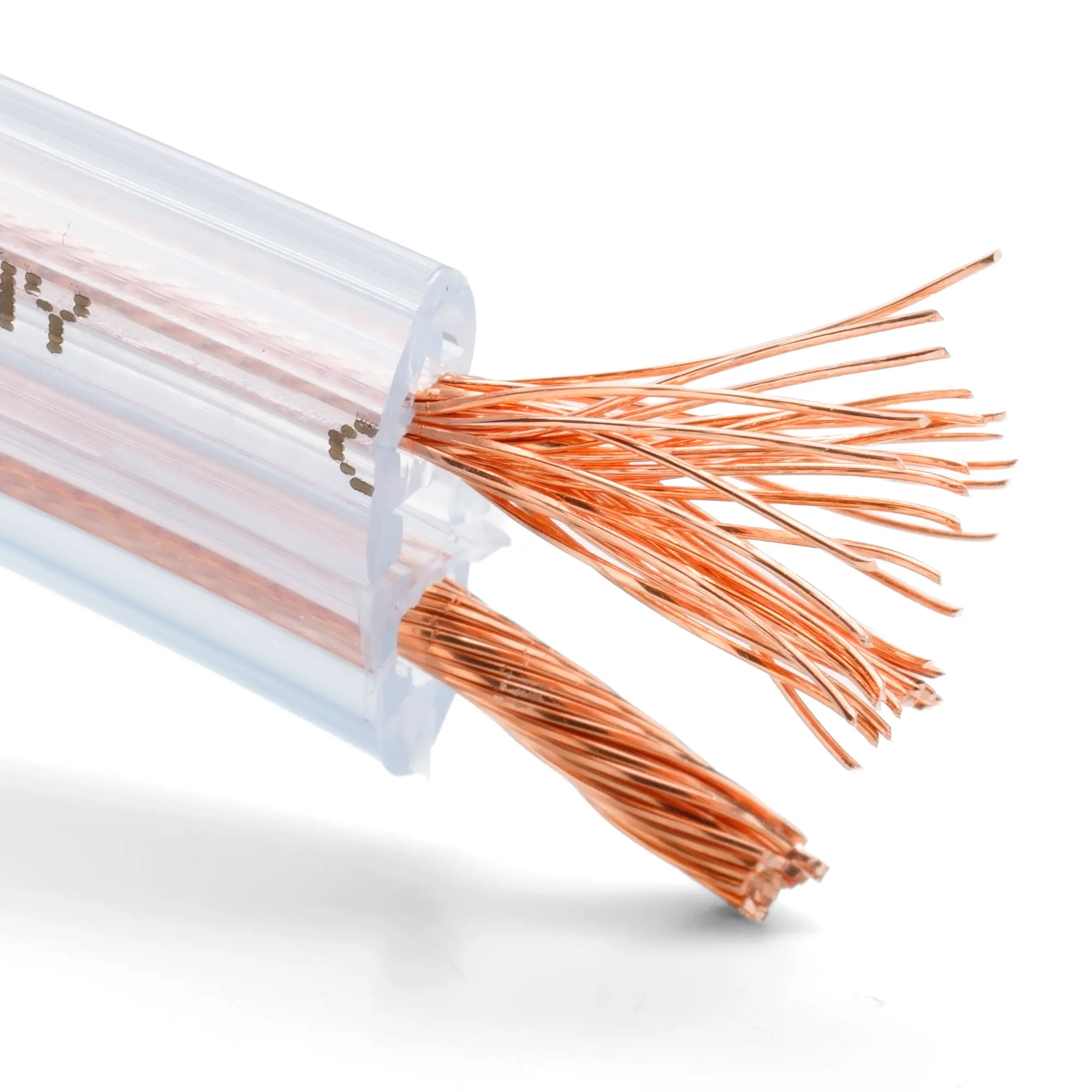
Under normal conditions, copper is the next-best electrical conductor after silver. Compared to cheap CCA (Copper Coated Aluminum) in particular, copper has a significantly better conductivity and is also mechanically more resilient. The wires of the Premium LS-CU speaker cable are made of particularly high-purity copper. A conductor cross-section of up to 4 mm² provides the basis for a powerful and dynamic sound. Stranded wire is a tried-and-tested conductor design. In the Premium LS-CU speaker cable, the strands consist of 30 x 0.25 mm - speaker cable 1.5 mm² 50 x 0.25 mm - speaker cable 2.5 mm² 84 x 0.30 mm - speaker cable 4.0 mm² wires "braided" together. The advantage of this design lies in the mechanical flexibility, which increases with smaller diameters of the individual wires. For cost reasons, many loudspeaker cables use the same stranded wire with the same stranding direction for both the positive and negative conductors. However, these cables are not easy to lay and tend to get tangled due to the torsional forces acting on the strands in the same direction. This can be remedied by using stranded wires with different stranding directions for the positive and negative conductors. The opposing torsional forces cancel each other out and the cable can be laid more easily and smoothly.


The Premium LS-CU Flat speaker cable is the ideal solution for anyone seeking high-quality audio performance without visible cable clutter. With its extremely flat design of just 4 mm thick, it can be effortlessly routed under carpets, behind baseboards, or along wall edges – invisible and space-saving. The highly flexible conductors consist of the finest braided strands with a 0.7 mm² cross-section per core (total 2 x 2.5 mm²). Unlike rigid stranded constructions, this design offers exceptional flexibility that masters even tight curves and complex routing paths without compromising performance. Perfect for home cinema applications: Whether 5.1-, 7.1-, or even Atmos setups – the LS-CU Flat supplies all speakers with ample power and delivers precise, powerful sound. The high-quality pure copper construction ensures minimal signal loss and natural reproduction that holds up even in demanding scenes. This cable combines functionality with HiFi quality: discreet in use, convincing in sound – the smart choice for modern living spaces and ambitious home cinema builders.


The in‑akustik Premium LS‑SILVER speaker cable combines high-quality materials with precise engineering to deliver dynamic, detailed, and transparent sound reproduction. The conductors are made of high-purity copper – the best electrical conductor after silver under normal conditions. Compared to copper-clad aluminum (CCA), pure copper provides not only superior conductivity but also greater mechanical durability. An additional silver plating on the conductor surface enhances high-frequency performance, providing clear, open, and nuanced detail reproduction. The strand structure is proven and precisely engineered: 30 × 0.25 mm - 1.5 mm² speaker cable 50 × 0.25 mm - 2.5 mm² speaker cable 84 × 0.30 mm - 4.0 mm² speaker cable The wires are twisted together (“stranded”), increasing mechanical flexibility, especially with smaller individual wire diameters. Another advantage of the Premium LS‑SILVER is the opposite strand twisting (S/Z twisting) of the positive and negative conductors. Conventional cables with strands twisted in the same direction can be difficult to route and may tangle. With opposite twisting, torsion forces cancel out, allowing the cable to be handled and installed smoothly and neatly. With conductor cross-sections up to 4 mm², the cable provides a solid foundation for powerful, dynamic, and detailed sound reproduction, suitable for both stereo and home theater applications. The Premium LS‑SILVER is the ideal speaker cable for audiophiles who value high-quality materials, precise construction, and uncolored signal transmission.


The LS-14-CU flame-retardant speaker cable has been specifically designed for permanent building installations where both fire safety requirements and reliable signal transmission are essential. Certification according to EN 50575 Class Eca complies with the Construction Products Regulation (CPR) and enables use in professional installation environments. The conductor consists of 50 individual copper strands with a diameter of 0.25 mm each, forming a total cross-section of 2 × 2.5 mm². This construction provides an excellent balance of electrical conductivity and mechanical stability for long-term installations. The talc-coated PVC jacket simplifies stripping and ensures convenient handling during installation. Clear conductor color coding (Red / Blue) allows quick polarity identification, making installation faster and more straightforward. With its robust construction, standards-compliant flame rating, and installation-friendly design, this cable is a reliable choice for speaker wiring in buildings, conference rooms, training facilities, and professional audio installations.
If You Want to Go One Step Further: Excellence LS-40
If your system is already approaching the $2,000 to $3,000 range, or if you know that you are likely to upgrade it further in the foreseeable future, it can make sense to look one level higher. That takes you directly into our Excellence range.
One of the cables you will find there is the LS-40. With this cable, construction features become more important alongside conductor cross-section and material. One example is its multicore design. The multiple nested conductor structure reduces inductance and provides greater precision and punch.
If you already know that your first upgrade will not be your last, it is also worth looking at the three cables in our xcellence S25 range. These cables are hand-assembled in our manufacture and are available in lengths of 2 m, 3 m, 4 m and 5 m.
But there is no pressure. Starting with the Premium LS-CU now and upgrading again later is a perfectly sensible approach. The Premium range is not a budget alternative. It is a carefully developed cable range in its own right, and its cables offer excellent value when matched with the right level of system.


The S25 Speaker Cable 425 is the most powerful model in the series, designed for audiophile setups with high power reserves and long cable runs. The large conductor cross-section and low-inductance multicore design ensure exceptionally low-loss transmission – even under high load or long cable lengths. The sound benefits from a particularly controlled, deep-reaching bass with precise punch, clearly defined mids, and an open, detailed high-frequency reproduction. The spatial presentation is stable and wide. Thanks to high-quality materials such as fine-stranded OFC copper, solid crimp contacts, and gold-plated connectors, the signal remains unaltered along the entire length. Its discreet, functionally elegant design and surprisingly high flexibility despite the large cross-section allow for neat, unobtrusive installation – even in complex rack setups or close to walls. Click here to discover exciting details


Inductance is a critical behavioral feature of a cable, causing resistance to the signal flow, rising with the frequency. Multicore architectures, such as that of the LS-40, reduce this effect and bring more precision and punch to the sound. The conductors of the LS-40 are made of high-purity copper. Under normal conditions, copper is the next-best electrical conductor after silver. Compared to cheap CCA (Copper Coated Aluminum) in particular, copper has a significantly better conductivity and is also mechanically more resilient. The stranded wire design is a tried and tested conductor design in the hi-fi sector. Each conductor consists of 50 x 0.25 mm strands that are "twisted" together. The advantage of this design lies in the economical method of production and the mechanical flexibility, which increases with smaller diameters of the individual wires. The conductor cross-section of 2x5.0 mm² is the foundation for a dynamic and powerful sound. The polyethylene (PE) insulation of the LS-40 has very good electrical properties. Compared to PVC, it halves the annoying battery-like capacitance of cables. The reproduction gains in brilliance and spatial quality. The PE network jacket protects against mechanical damage and serves as additional insulation.

The LS-Atmos AIR speaker cable uses Atmos AIR technology to create optimal conditions for precise signal transmission. The design aims to utilize air - an ideal dielectric—as extensively as possible between the signal conductors. At the center of the electric field between the conductors, a defined air chamber is integrated into the cable structure. This reduces capacitance and dielectric losses and helps preserve the integrity of the audio signal. Another key feature is the Concentric Copper conductor design. Each individual copper strand is positioned in a precisely defined location within the conductor. Unlike conventional stranded constructions, where the relative position of the strands continuously changes, this geometry remains stable. The result is consistent electrical properties and controlled signal transmission. The combination of air insulation and a precisely defined conductor geometry supports transparent, detailed sound reproduction with excellent dynamics and natural tonal balance. The LS-Atmos AIR speaker cable is designed for demanding hi-fi enthusiasts who value high-quality materials, thoughtful engineering, and accurate signal transmission.


The LS‑MSR speaker cable is part of in‑akustik’s excellence series and uses the classic MSR technology, based on proven designs from the 1990s. The cable features a twin‑line construction with generous conductor cross-sections, providing a solid foundation for powerful and controlled signal transmission. The conductors are made of high‑purity copper, which offers excellent conductivity and mechanical resilience compared to copper-clad aluminum (CCA) alternatives. This ensures consistent electrical performance and long-term reliability. The fine-stranded conductors 651 x 0,07 mm - speaker cable 2,5 mm² 1050 x 0,07 mm - speaker cable 4,0 mm² 1575 x 0,07 mm - speaker cable 6,0 mm² give the cable high flexibility, making installation and routing easier. Clear plus/minus identification via color coding allows for straightforward connection. The LS‑MSR is sold as metered cable and can be fitted with connectors according to system requirements. The LS‑MSR speaker cable is suitable for hi-fi setups where solid electrical fundamentals, flexibility, and reliable signal transmission are a priority.
How to Proceed – in Three Steps
1. Measure the length generously It is better to have 50 cm too much than to be 20 cm short. Measure from the rear of your amplifier to the speaker terminals, following the actual cable route – around furniture rather than straight through a wall – and add around 30% extra length
2. Check the connections – banana plugs or spade connectors? Take a look at the terminals on your amplifier and speakers. Are they simple spring terminals or binding posts? If they are binding posts, you can usually choose between banana plugs and spade connectors. For simpler terminals, we recommend flexible pins. You can find suitable connector options on our accessories page.
3. Compare honestly. Before getting rid of your old speaker cable, keep it for another week. Listen to the new cable for a few days in a relaxed way and then reconnect the old cable briefly. The most honest way to notice a difference is often when you go back.
What should you listen for?
Choose three or four tracks you know extremely well – perhaps a quiet singer-songwriter recording with vocals and acoustic guitar, a small jazz trio, a string quartet or a well-produced pop recording.
Listen first with the old cable, then with the new one, and then with the old one again. The difference will usually be less about “louder” or "quieter" and more about detail: how clearly voices separate from the background, how clean quiet passages remain, and how precisely individual instruments can be located within the soundstage.
If you do not notice anything in the end, that is also an honest result. Either your system is not yet at a level where the cable makes a meaningful difference, or your listening room has other issues that are more important to address first. There are no miracles in the world of speaker cables – only honest results.

Conclusion
A high-quality speaker cable should not be the first thing you upgrade in your system. But once the rest of the system has reached the right level, it can be the most sensible next step. A good cable does not need to promise miracles. It simply needs to perform its technical function properly, and the best way to find out whether an upgrade is worthwhile for you is to listen for yourself. A cable from the Premium range gives you an easy entry into the in-akustik product range. You will not recognize the difference through audiophile buzzwords, but through specific things you can hear: a familiar voice on your favourite album may sound more present, individual notes in a quiet piano piece may be more clearly separated, and low-level passages may remain clean rather than becoming rough. No miracles. No magic. Just an unaltered signal arriving as faithfully as possible.
FAQ: Speaker Cable Upgrades

Transrotor & in-akustik: AIR Technology for the Tonearm
A Transrotor tonearm fitted with an in-akustik AIR cable. The story behind this collaboration – and a surprising listening test.

Speaker Cable – When Is It Worth Upgrading?
When does it make sense to replace the standard cable supplied with your system with a high-quality speaker cable? We explain at what level of system performance an upgrade becomes worthwhile.

HDMI 2.2: What does the new standard offer?
Read this blog article to learn why HDMI 2.2 promises a lot, but is not yet essential for today’s setups - and why high-quality HDMI 2.1 cables are often the better choice right now.

New Connector Generation
The new connector generation for our AIR speaker cables makes installation significantly easier while complementing our proven AIR technology with an intelligent new connection system.

Sound Tuning
Our guide "Sound Tuning", written by renowned HiFi and music editor Lothar Brandt, provides you with 10 practical tips on how to noticeably get more out of your HiFi system – without expensive new purchases.

News Release: s.a.m. !
s.a.m. – selected audiophile music Vol.1: Discover the successor to our legendary Reference Sound Edition. s.a.m. is based on the advanced RESO Mastering 2.0 – a consistently refined version of the proven RESO technology. Available as U-HQCD and 180g double LP.

Analog, Close to the Original: Our Master Tapes
Our new master tapes combine craftsmanship, technology, and music history. Three editions – Start, Standard, and Studio – offer access to authentic sound. In this article, we explain the differences and background.

AC-3200: High-End Power Strip & Power Conditioner
The AC-3200 delivers clean, interference-free power, noticeably enhancing clarity, dynamics, and soundstage tranquility in your audio setup. Try it free for 14 days and experience how superior power quality can refine your sound!
