
High resolution audio – high resolution, or just brilliant deception?
In the age of completely digital music production, reproduction and transfer, high resolution is a hotly discussed topic, or among audiophiles it is at least. Proponents talk about decisive advances in sound – opponents about dubious profiteering. The one thing opponents do agree on, is that they don’t agree.
Disambiguation
Let's start the discussion by explaining some terms. “High resolution” is at home in the digital domain, so there where music is recorded, stored, played back and/or transported as data, and therefore ultimately as zeros and ones. In what was once the dominant analog realm, of course, relevant criteria such as signal-to-noise ratio, dynamic range, frequency response and low distortion also applied.
Here, however, they have to deal directly with the storage or reproduction hardware, so with the shellac record and the horn gramophone, the tape and the tape recorder, vinyl record and record player, and then also the modulated transmission frequency or amplitude (FM or AM radio) and the receiver (tuner). In today's dominating digital world, the above mentioned criteria depend only indirectly on hardware or software, at least in theory and therefore mathematically/computationally.
Firstly however, they depend on the data format and what the reproduction chain can reproduce from it. The digital-to-analog converter is still the key factor here, as it sits between these worlds and converts abstract numerical values (a Beethoven sonata or a Beatles evergreen is not a series of zeros and ones to our analog ears) into specific voltage curves that an amplifier can amplify and a speaker or headphones can in turn convert into sound and therefore into music.

Basics
In the digital domain “high resolution” or “hi res audio” today are data formats that mathematically offer a higher resolution than the CD format commercially introduced circa 1982. This means that more data depth and/or a sampling rate higher than 16 bits and 44.1 kilohertz are available for the original graph curve that reproduces the music or the signal.
If we want to understand what resolution and therefore also high or higher resolution mean, we should do a little basic research. At the beginning of the CD age we usually imagined it as a curve around which a kind of stairs formed. The height of the individual steps or the maximum height of the stairs represents the bit rate. The width stands for the sampling frequency – so how often the curve was recorded per time unit.
Without being able to go into this in very much detail here: The inventors of the CD, and the Pulse Code Modulation (PCM) it is based on, referred in this respect to Harry Nyquist and Claude Elwood Shannon’s (who also had predecessors) sampling theorem. This means a signal with a limited frequency range can be adequately reconstructed again, if it has been sampled at least twice that of the highest frequency in it.
The human ear, or at least an infant’s or small child’s, hears up to circa 20,000 vibrations per second, so 20 kilohertz (KHz). The CD developers therefore specified 44.1 KHz as the sampling frequency, while their colleagues responsible for film sound decided on 48 KHz – a sampling frequency, to which the short-lived Digital Audio Tape (DAT) data format was also “tuned”.
The data depth on the other hand, was set at 16 bits, although in the early days of DA converters, 14 bits were also permitted. So now we are back to the curve, whose combined maximum upward and downward extension will deliver the dynamic range, so the distance between the highest (loudest) and the lowest (quietest) point. Each bit means a doubling, therefore six decibels (dB) more dynamic range. In theory 16 bits can thus deliver 6 x 16 = 96 dB of dynamic range, with14 bits still delivering 84 dB.
The dynamic range of an immense symphony orchestra is about 60 dB, as it is in a rock concert between any break and maximum noise. The 0 dB hearing threshold is never used in practice, except perhaps in an anechoic, hermetically sealed room. Even in extremely quiet situations we are surrounded by at least 30 dB ambient noise, which is offset by a pain threshold of 120 to 130 dB.
The CD – not the savior we thought it was
The CD, or the 16/44.1 data format specified in the “Red Book”, theoretically can therefore store the entire musical spectrum. In practice the data density of 65536 x 44100 = 2.89 megabits per second (Mbps) and per stereo channel should be sufficient. Right?
Even early on in the CD age, music lovers (and not just the eternally old-fashioned ones) were already grumbling about the sound quality of CDs. So, the frequently criticized “sterility” can be explained psychologically by the fact that the absence of any kind of “impurities” (hissing, groove noises, humming) made the signal unusually clear and therefore somehow unnatural.
But there was more missing here. As we know today, the respective studio technicians were still unable to optimally manage the new format. The multi-track technology, the mixdown and mastering that had long been established in the studio was also inadequately equipped hardware-wise on the digital side (and above all the DA converters built into consumers’ CD players still left a lot of room for improvement), so no sign of high resolution audio yet!
In the studio
The digital pioneers in the recording studios figured things out pretty quickly. On one hand the 16 bits simply weren’t enough for the consoles and their effects, for the numerous improvements in sound design and the multi-mono extravaganzas with 24 and more tracks – more "headroom" was required here. But above all, the professionals (and later also the golden ears of high enders) were bothered by the extremely sharp filtering, which necessitated the 44.1 KHz sampling frequency.
If you wanted to allow a storage and therefore transmission range of up to 20 KHz, then you had to use extremely sharp filters, you might even say “brutal” filters, which cut the sampling frequency out of the useful signal. If you didn’t do this, very unpleasant and clearly audible components would be mixed into the useful signal (aliasing). These brutal filters, however, showed adverse side effects such as phase rotations.
Studios, at least those that could afford it, quickly turned to internal signal processing with more bit depth and higher sampling frequencies. Storage space was still expensive, and computing speed was limited. So we’re in the 1980s. Oversampling quickly established itself on the consumer side – with Philips and followers, 14-bit/quadruple oversampling, with Sony and licensees, 16-bit/double oversampling. 16-bit/quadruple oversampling chips were then available in the mid-80s. Oversampling didn’t of course generate more data on the transmitter side (the CD), but on the receiver side it delivered a significantly higher sampling frequency with 176.4 KHz, which could be filtered out of the useful signal much easier and with fewer side effects.
In far-off Japan, CD co-inventor Sony had meanwhile acquired the Columbia/CBS record company, and with it its early classical recordings. The Sony technicians quickly also realized that the lifespan of analog tapes with the recordings of greats such as Bruno Walter was limited. A digital format that offered more than CD-PCM was required to preserve them “for eternity”. After a few experiences with “one-bit” converters, which, to put it very simply, replaced additional bits with even higher sampling rates of 2.8 megahertz (MHz = 1,000 KHz), so about 64 times the sampling rate of the CD, Sony and participating companies developed Direct Stream Digital (DSD).
-

Hi-res audio with Primare
Our partner Primare's Prisma technology supports numerous platforms for integrating and controlling hundreds of music services, including those with hi-res audio offerings.
Learn more -
Hi-res audio with Primare
Our partner Primare's Prisma technology supports numerous platforms for integrating and controlling hundreds of music services, including those with hi-res audio offerings.
Learn more
On sound carriers and "non-physical"
The studio technology, of course, also made inroads into home electronics. DSD 64 became the data format for the Super Audio CD, while the higher PCM formats such as 24/96, would delight consumers on Digital Versatile Discs for audio (DVD Audio). It happened as it had to happen. There were only losers with the format row – DVD Audio is history and SACD only lives on in a very limited niche. The CD remained the mass format, until the digital revolution began to gobble it up.
only from the other side, the not high-end, expensive side, but the crummy-sounding, cheap side. The Fraunhofer Institute developed the MPEG Audio Layer III into the data-compressed mp3 format, which revolutionized and simplified the storage, transport and thus the exchange of music files.
In Europe license-free since 2012 and in the USA since 2017, mp3 quickly became the unofficial standard for coded (or data-reduced) music on the Internet and on servers, cell phones and the kids' sticks. And how reduced it was – up to 85 percent of the amount of CD data could be pared down. With data rates of 192 kbit/s (with many Internet radios even far less) this gave audiophiles the creeps, but consumers weren’t bothered about sound quality. The reason? Storage space was still expensive, the data transfer speed in the data networks was slow and the sharing platforms tempted users with the allure of the illegal.
In the stream
In the digital age, of course, clocks run differently – much, much faster than in analog times. Even in digitally developing countries such as Germany, the transmission rates of the data networks are now quite fast, and even enormous record collections now fit onto affordable data carriers. But more than anything else, several providers offer almost unlimited music, which mainly applies to quantity, but now also to quality. While at the beginning of streaming services, only “low-fat” data volumes were available to stream or download, today providers are wooing users with high resolution.
And so the triumphal march of "bodiless" music and music playback would now appear unstoppable, and especially with consumers. In 2019 the number of music streams in Germany surpassed the 100 billion mark. By 2023 the market share of non-physical sound carriers in total music market sales of EUR 2.21 billion in Germany already amounted to 81.5% – trend still rising.
Most of these are of course individual songs or snippets (the statistics of the German Music Industry Association count music streams of 31 seconds or more), but the musically and tonally demanding public also likes to drift along with the flow of time
And modern network technology makes it possible. Increasingly more affordable storage space on increasingly smaller areas and increasingly higher data transfer speeds with correspondingly powerful cables and interfaces have brought massive development boosts. Where high-resolution moving images can now flow easily between the digital transmitter and receiver, the comparatively far less data-intensive audio flows along streamlined, even when it gets there in high resolution.
For number fans: The CD format with 16-bit word width and 44.1 kilohertz sampling frequency needs some 2.8 million bits per second (2.8 Mbps), including preamble and status bits. With high resolution material with 24 bits and up to 96 kilohertz sampling frequency, this already amounts to 6.2 Mbps. The high res audio bit transport rate (9,216 kbit/s) is also about 7 times higher than that of CDs (1,411 kbit/s) and almost 29 times higher than that of MP3 files (320 kbit/s)..
By the way, this is one of the reasons why “wireless” hi-res file transfer is still in its infancy to some degree. On a side note: Even the transfer of big digital data volumes via cable is ultimately analog. The difference is the zeros and ones have to rush through at an almost high-frequency speed. But HiRes audio still requires significantly less than moving images require. For normal HD images (data is basically reduced with the image transmission), the relevant committees recommend a minimum of 27 Mbps.
Audio streaming now works completely problem-free on two levels, with the appropriate hardware. One level is the home network. A server connected to the router, so a correspondingly dimensioned mass storage unit, but it can also be a smartphone, contains your own music collection, and sometimes the corresponding administration program as well. The other level is the big wide world of the Internet, where streaming services such as Qobuz, Spotify and Deezer offer their colossal music collections, including new releases and in places, for a surcharge, in high resolution.
Streaming Cables

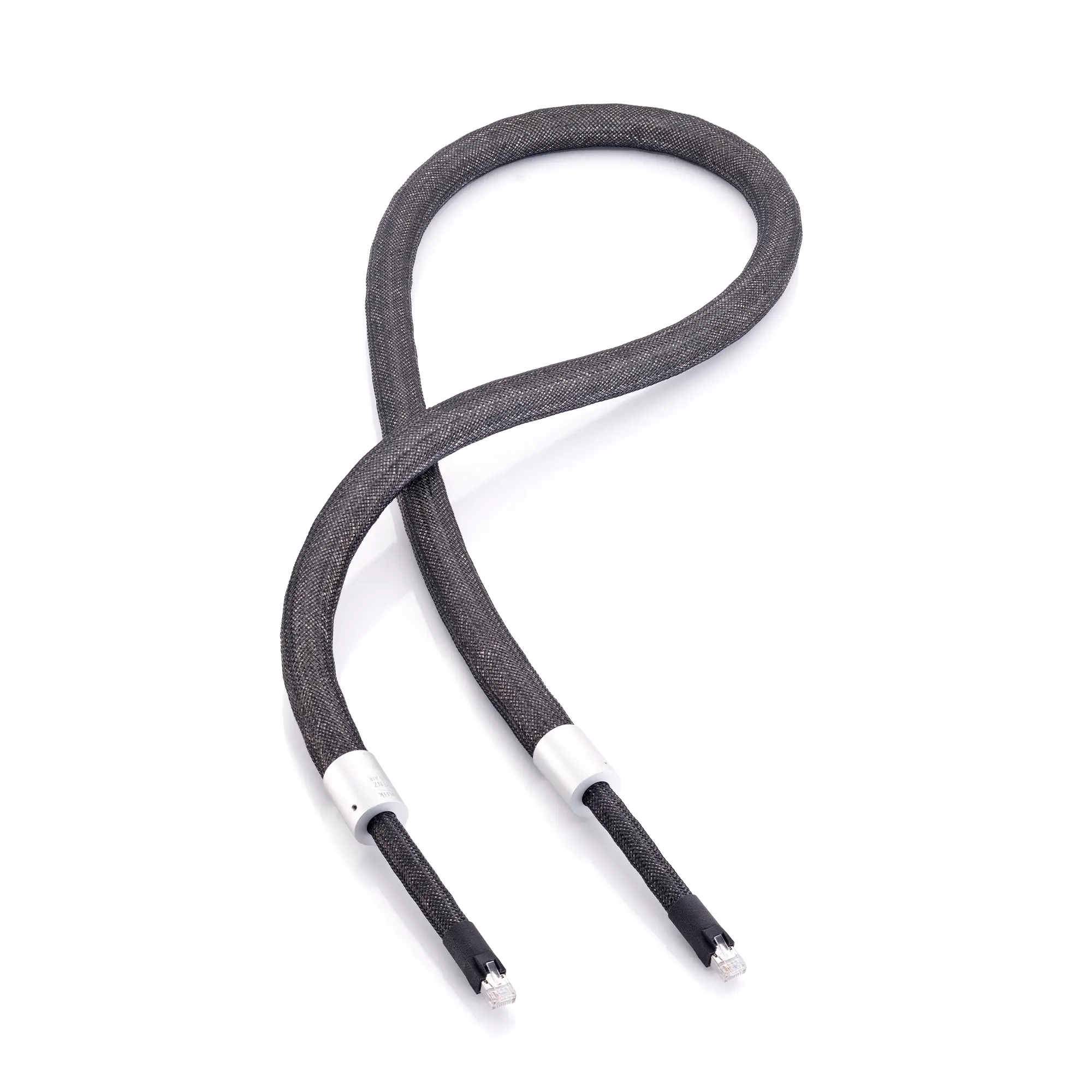
The CAT-2405 AIR is a high-end LAN cable designed for connecting audio components in streaming setups. It is based on our specially developed Air Helix construction, which enables low-loss and interference-resistant signal transmission. For this construction, we have designed a special clip that forms a stable supporting framework inside the cable. Several of these clips hold the signal pairs in a helical shape and at a defined distance freely in the air. The entire arrangement runs within a high-density shield. Two connecting bridges keep the clips evenly spaced and at the same time provide the necessary flexibility in the cable structure. Digital signal transmission: In mathematics, digital information is represented as binary values, but technically it is transmitted via analog voltage curves. To distinguish between states such as "0" and "1", voltage thresholds and time windows are defined. The transition between these states does not occur abruptly, but continuously—the signal passes through intermediate values, for example, between 0 and 5 volts. Capacitive loads, dielectric losses, noise, and external electromagnetic influences can distort these transitions. This results in timing shifts in the signal, known as jitter. Jitter makes it harder to assign data precisely in time and impairs the reconstruction of digital audio signals. Advantages of the Air Helix construction: The overall shielding made of dense braid, as well as additional foil shields for each pair of wires, effectively protect against external interference. The Air Helix construction uses air as a dielectric and ensures a constant distance between the wire pairs. This arrangement reduces crosstalk and capacitive losses, contributing to unadulterated signal transmission. Streaming components and integrated digital-to-analog converters (DACs) benefit from the improved signal quality and can process data more precisely. CAT connector with rotation mechanism: Conventional RJ45 connectors can only be plugged in at a fixed orientation. Depending on the position of the socket, this can result in unfavorable cable routing and mechanical stress on the connector, cable, and socket. To counteract this, we use rotatable RJ45 connectors with a 180° mechanism. Each connector can be rotated by about ±45°, resulting in a total adjustability of about ±90° between both connectors. This allows the cable to be routed without tension and in a space-saving manner. Sound Advantages at a Glance: Air Helix construction: Signal pairs arranged helically in air—minimal capacitive losses Air as dielectric: Reduces crosstalk and improves signal purity High-density shielding (tinned): Overall and pair shielding against electromagnetic interference RJ45 connector with 180° rotation mechanism: Flexible, tension-free cable routing Optimized for high-end streaming: Supports precise clocking in digital audio transmission Conductor material: High-purity OFC copper for stable, low-loss transmission Technical specification: CAT 8.1—up to 2000 MHz bandwidth Made in Germany: Development, manufacturing, and quality assurance on site Click here to discover exciting details

High-quality network cable with CAT 7 cable and compact CAT6A RJ45 plugs for professional installations. The cables are designed for high-speed networks with up to 10 Gigabit. The plugs are equipped with a locking lever and have gold-plated contacts. Each cable is individually tested in accordance with ISO/IEC11801.


The Air Helix construction of the Referenz USB-2405 AIR is truly unique. To achieve an almost perfect air isolation, we developed a special clip system. Inside the cable, a large number of these clips form a supporting structure that keeps the signal conductors suspended freely in air in a helical arrangement and guides them through the high-density shielding at a precisely defined distance. The flexibility of this construction is achieved through two support rails that not only hold the clips together but also maintain the exact spacing between them. Strictly speaking, the term “digital” only exists in mathematics in the form of the binary number system. In the technical world, there are no purely digital signals. To detect zeros and ones, defined voltage thresholds and timing windows are used. The transition from a zero to a one, or vice versa, always requires a certain amount of time during which the signal level passes through all intermediate values, for example from 0 volts to 5 volts. Capacitive loads, dielectric losses, noise, and electromagnetic interference caused by cables can further influence this transition. This results in timing deviations known as the jitter effect, making precise reconstruction of the audio signal more difficult or even nearly impossible. To get closer to the pinnacle of audiophile perfection, we also carefully examined the conductor material. Copper with the right purity is already an excellent conductor, but a superconductor with no ohmic resistance would be the ideal solution. However, superconducting properties require extremely low temperatures of at least -70°C. Under realistic conditions, silver is currently the most conductive material available. With a conductivity of 61.35 S/m (siemens per meter), it outperforms copper by around six percent. Many manufacturers use silver-plated conductors, which over time can result in a sound character often described as "bright," "metallic," or even "harsh." We use pure silver conductors instead, which provide a much more neutral sonic character. Due to the higher electron mobility, our pure silver cable delivers a more detailed and powerful sound performance across the entire frequency range. Silver, of course, is also around one hundred times more expensive than copper. USB connectors are known to only fit in one direction. This can be inconvenient, as the position of USB ports varies between devices. To adjust the cable routing, the cable often needs to be twisted significantly, placing stress on the cable, connectors, and sockets while also affecting the overall appearance of the installation. Our newly developed USB connectors with a 180° rotation mechanism provide the solution. Each connector can be rotated by ±45°, meaning that a total rotation of ±90° from one connector to the other is possible. This is the final refinement for a perfectly installed cable connection. The dense shielding of the Referenz USB-2405 AIR protects the sensitive signal from electromagnetic interference. Beneath the shielding is the innovative Air Helix construction, where air and the precisely defined spacing between the conductors act as the dielectric, preventing dielectric losses and significantly reducing capacitive loading. Together, these design elements make it easier for the digital-to-analog converter (DAC) to process the signal and help optimize the reconstruction of the audio signal.


The air helix design of the Referenz USB-2405 AIR is entirely unique. We’ve developed a special clip to achieve practically perfect air insulation. Inside the cable, in the right numbers these clips form a supporting structure that keeps the helically-arranged signal conductors apart in the air, and guides them through the high-density shielding at a specific distance from each other. The flexibility of this structure is ensured with two struts, which both hold the clips together and fix them at an exact distance from each other. In the proper sense of the word, “digital” only exists in mathematics in the form of the binary number system. There are no purely digital signals in the technical world. Electrical voltage limits and time windows are defined to detect zeros and ones. The jump from a zero to a one or vice versa always requires a certain time, during which the signal level passes through all intermediate values, from 0 volts to 5 volts, for example. Capacitive loads, dielectric losses, noise and electromagnetic interferences caused by cables additionally manipulate this change. This results in temporal shifts, or the, “jitter effect”, which makes precise reconstruction of the audio signal difficult or almost impossible. New 180° USB connector: As we know, USB connectors can only be inserted in one direction. This can be difficult, as the position of the USB sockets in devices varies. To adjust the course of the cable, it often has to be twisted quite a lot, which puts strain on cables, connectors and sockets and also looks unsightly. Our recently developed USB connectors with 180° rotation mechanism offer a solution: Each one can be rotated by +/- 45 degrees, enabling a total rotation of +/- 90 degrees from connector to connector, thus providing the finishing touch for perfect cabling. The dense shielding of the Referenz USB-2405 AIR cable protects the sensitive signal from electromagnetic interferences. Under the shielding is the innovative air helix structure, where air and the spacing between the conductors act as insulators, preventing dielectric losses and significantly reducing capacitive loads. On the whole this makes the digital-to-analog converter’s (DAC) work easier and perfects the audio signal’s reconstruction.
So what's the benefit?
This is where audiophile happiness might begin – but instead, new problems arise. Hi-fi fans report again and again that brand new “high-bit” re-masterings of old music gems sound even worse than old CDs. So what's going on? When the CD age began, engineers still had an extremely limited arsenal at their disposal to convert analog recorded classics into digital format, which at the time was 16/44.1 of course.
Today we have a box packed full of tricks, and some sound engineers succumb to the temptation of also using them – a bit more keynote here, a tad more overtones there, a little more spatiality here, some more presence there, a bit more reverb here, and a little more compression there. The new work of art is ready, and no longer sounds real, whether it is offered as a final product in high resolution with 24/96 or mp3 with 320 kbit/s.
So, remember our oversampling from the basics section? Well today we have upsampling, which means that an early CD master or an analog transfer with 16/44.1 is hyped in the computer up to 24/96, without changing the sound at all.
The sound even gets worse sometimes, losing clarity and directness. The professional is happy they can offer higher resolution, ordinary folk wonder why it still sounds like this. And there is also cheating with fake labels, but most laypeople will find it difficult to prove wrongly “labeled” hi-res files – most people can only rely on their ears. And all too often they are also disappointed when it comes to remastering.
Sound engineer Ekkehard Strauss said it straight up once in a fundamentals article: “The productions of big stars of the late 80s and the 90s in particular, such as Prince, Michael Jackson, Madonna or Sting, as well as countless classical recordings, which used digital multi-track recording systems that at the time were considered the pinnacle of audio technology, even evade any remixing or remastering processes entirely with the high resolutions we expect today. With analog multi-track tapes, things look far more hopeful from a purely technical point of view, the financial hit, however, is substantial.” And the record companies increasingly have less and less money.
Sound engineer Ekkehard Strauss said it straight up once in a fundamentals article: “The productions of big stars of the late 80s and the 90s in particular, such as Prince, Michael Jackson, Madonna or Sting, as well as countless classical recordings, which used digital multi-track recording systems that at the time were considered the pinnacle of audio technology, even evade any remixing or remastering processes entirely with the high resolutions we expect today. With analog multi-track tapes, things look far more hopeful from a purely technical point of view, the financial hit, however, is substantial.” And the record companies increasingly have less and less money.
Lindberg offers the new productions of his 2L label run in “DXD” with, wait for it, 24/352.8 Khz multi- and two-channel in 24/192, and that on Bluray “Pure Audio” disks. On a second disk, a hybrid SACD that CD players can also read, the music material is provided in DSD64.
Plus, hi-fi magazines never tire of listing the rates that the built-in central chip, today usually a “Sabre” from California-based ESS, can process in the test for each digital-to-analog converter (DAC). 24/192 is the minimum on the PCM side. On the DSD side it goes up to DSD 256, so a data stream with 256 times the CD sampling frequency. With all due respect – there is hardly any music that leaves the studio in such high resolution. And for sure none of the rampant “home recordings” data carriers.
And then there is always the killer argument that is always floated in the age of dynamic compression. In the pop and rock sector, today’s dynamic range is usually between just three and six dB. So what are 24-bit depths about, which in theory would be a 144 dB dynamic range? And which, if actually used and implemented with correspondingly level-stable equipment, would literally kill a potential listener. Second killer argument: Adults, of course, only hear up to a maximum of 10 KHz anyway. So why use high sampling rates to bring frequencies with a theoretical 48 KHz into the equation, which can only be heard by bat ears?
Argument one then: No hi-fi amplifier offers a 144 dB dynamic range – no hi-fi loudspeaker can be that loud. But in studio technologies, the more intensive the processing is, the more high bit rates are required – that’s how it is today. And if digital volume control is added in, even on the playback side, high bit reserves are usually highly beneficial.
And argument two: The high-performance computer in our cerebrum, the auditory center, can simply do so much. Even with just the small amount that the ear’s upstream mechanics provide, it can calculate additional information incredibly precisely. Otherwise we would never recognize Aunt Mildred from the squawking speaker of a smartphone or Uncle Herbert from the depths of his bathroom. But “calculating” needs energy, it’s bloody tiring. The less the “central computer” has to calculate, the more relaxed we can listen. So we’ll give it the best on the playback side.
Studio cracks, however, for the most part have a pretty relaxed relationship with increasingly higher bit and sampling rates. The ingenious, Grammy-winning Swiss studio equipment pioneer, Daniel Weiss, now also successful in the hi-fi business, believes 24 bit/96 KHz, which is now the unofficial standard in most studios, is “entirely sufficient”.
What’s really required
So now we come full circle back to our opening lines, and we’ll submit a “killer” argument of our own: High resolution audio is merely a means to an end. The audio quality, or how a recording sounds, only first depends on this in the third or fourth line. Much more important is the sound mixer’s, the engineer’s and the technician’s know-how. Into the mix then come the requirements of musicians and producers, who decide between “as loud as possible” and “as dynamic and differentiated as possible”.
There’s a good reason why some jazz and classical recordings from back in the 50s and some pop milestones from the 70s are still considered high-fidelity gems today.
How well and in what data format they are offered to us on the streaming platforms depends on the know-how, commitment and not least of all on the technical and financial resources of the overlay technicians two or three generations later. And so it is that some Supertramp records from the streamer are just annoying compared to the old LPs, on the other hand, however, Pink Floyd's “The Wall” in the 24/96 version can knock your socks off.
And as for the playback chain, there's another “killer” right here as well: The digital sound quality isn’t necessarily produced in the front end – for the most part it’s reliant on the quality of the DAC.
My conclusion
High resolution audio is simply wonderful. There are serious arguments for and against it. However, in and of itself, high resolution is not a criterion for high quality when it comes to good sound. It depends on what you make of it.


Sound Tuning
Our guide "Sound Tuning", written by renowned HiFi and music editor Lothar Brandt, provides you with 10 practical tips on how to noticeably get more out of your HiFi system – without expensive new purchases.

Pickup: MM or MC?
MM or MC – two cartridge principles, one common goal: the best sound. But how do they differ, and which one suits your turntable better? In this article, we break down what really matters.

The right HDMI cable
Find the perfect HDMI cable for your setup: Learn everything about standards, connector types, key features like eARC & VRR, plus tips on choosing the right length and proper handling to ensure the best picture and sound quality! A guest article by Raphael Vogt | lowbeats

High-Res Audio: Sound Revolution or expensive bluff?
High Resolution Audio promises the best sound quality. But is it really a revolution or just an expensive marketing ploy? Lothar Brandt explains the facts, myths and technical background.
