

Mini absorbers
Quality: Star€31.29


Product information "Mini absorbers"
The sub-absorber is made of a special rubber compound for optimum damping of vibrations between the devices and the locations on which they are standing.
| Application: | Decoupling of devices and loudspeakers |
|---|---|
| Load capacity: | 8 kg/(2 kg/pc.) |
| Dimensions: | 40 x 20 mm (D x H) |
| in-akustik product group: | Home HiFi |
| in-akustik category: | Accessories Home HiFi |
| Quality: | Star |
| Technology: | Special rubber compound for effective decoupling |
- Set of 4 Star Mini absorbers
If you have any questions about product safety, please contact:
in-akustik GmbH & Co. KG
Untermatten 12-14
79282 Ballrechten-Dottingen
Germany
Tel.: +49 (0) 7634 5610-0
E-Mail: service@in-akustik.de
Login




The sub-absorber is made of a special rubber compound for optimum damping of vibrations between the devices and the locations on which they are standing.
Using this jack adapter, all smartphones, laptops or other devices with a 3.5 mm jack can be easily connected to a mixing console, amplifier, AV receiver or other devices with a 6.3 mm jack socket. It is also suitable for connecting headphones with 3.5 mm jack plugs to hi-fi components with a 6.3 mm jack input.
Solid, gold-plated 3.5 mm stereo jack adapter with two cinch sockets (left & right).
The Premium doublettes in sandwich design consist of metal disks and special rubber for optimum damping of vibrations between the devices and the locations on which they are standing.
Wireless music enjoyment in the highest quality: With our Audio Bluetooth Receiver, you can wirelessly stream your favorite music to your HiFi system – all in impressive quality. Thanks to aptX® HD support, you'll experience music at a resolution of 48kHz / 24-bit, surpassing CD quality. Whether it's a smartphone, tablet, or laptop – the receiver is brand-independent and compatible with almost all Bluetooth-enabled devices.
Top-notch sound processing: The integrated Wolfson Digital Interface Chip ensures precise signal processing. The quartz clock technology minimizes jitter effects, providing clear and detailed sound reproduction – perfect for discerning listeners.
Flexibility through versatile connections: The receiver offers maximum flexibility: In addition to an analog 3.5mm output, there is an optical digital output (TOS-Link) available. This allows you to easily connect it to modern amplifiers or active speakers and customize your setup.
Convenient usage and extended range: With Bluetooth 5.1, you enjoy stable connections with a range of up to 20 meters (depending on local conditions). The receiver can store up to eight devices and automatically recognizes them, saving you time when reconnecting.
Easy pairing with NFC: For even more convenience, the receiver supports NFC. Simply hold your device near the receiver, and the connection will be established automatically – it’s that quick.
Technical highlights at a glance:
- Bluetooth standards: aptX®, aptX® HD, aptX® Low Latency, SBC codec, A2DP
- Range: Up to 20 meters
- Outputs: Optical digital output (TOS-Link), analog stereo output (3.5mm)
- Dynamic range: >95 dB
- Frequency range: 20 Hz – 20 kHz
Your gateway to the wireless audio world: Transform your HiFi system into a modern streaming system and experience music with all its details – wirelessly and effortlessly. Whether for daily music enjoyment or demanding listening sessions, the Audio Bluetooth Receiver is your perfect companion.
The Exzellenz Bolide shock absorber consists of a special rubber compound and an elaborate lamella design for optimum damping of vibrations between devices and the locations on which they are standing.
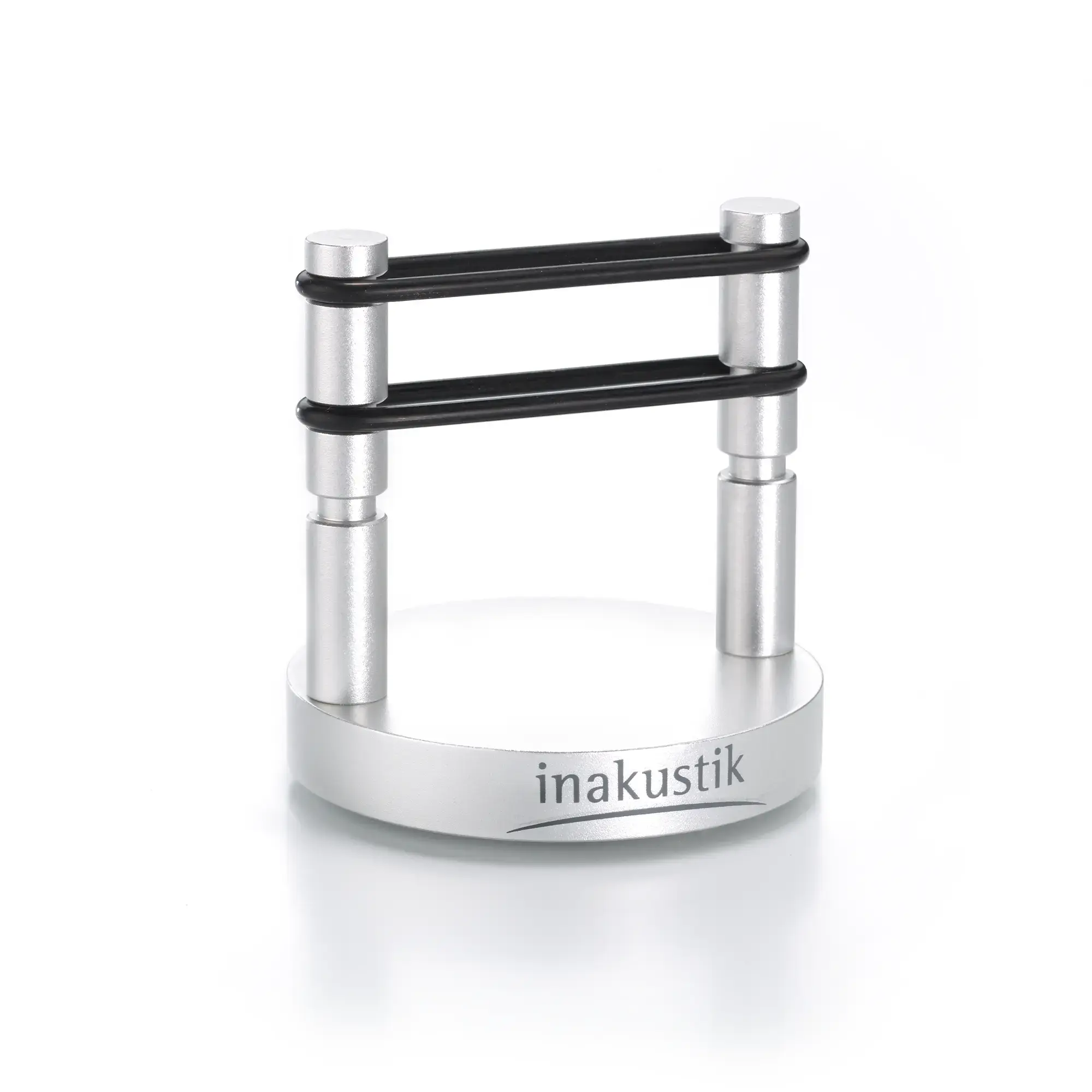
High-end and hi-fi systems are a combination of high-precision and filigree devices. Perfectly coordinated, they are capable of reproducing music in outstanding quality. However, in order for the components to work perfectly, they must be kept as free from interference as possible, just like high-precision measuring instruments. The same applies to the connection cables. However, interference can occur in many different ways. In addition to the typical electromagnetic interference, which can be minimized by good shielding, for example, mechanical vibrations and shocks also affect playback quality. The Referenz cable bases have been specially developed for cables. They also have a special gel incorporated in their base and additional natural rubber bands to accommodate the freely suspended cables. As well as absorbing vibrations, the Referenz cable bases also keep the cable at a distance from the floor, reducing unwanted capacitance and the impact on the electronics.
High-end and hi-fi systems are a combination of high-precision and filigree devices. Perfectly coordinated, they are capable of reproducing music in outstanding quality. However, in order for the components to work perfectly, they must be kept as free from interference as possible, just like high-precision measuring instruments. The same applies to the connection cables. However, interference can occur in many different ways. In addition to the typical electromagnetic interference, which can be minimized by good shielding, for example, mechanical vibrations and shocks also affect playback quality. The Referenz cable bases have been specially developed for cables. They also have a special gel incorporated in their base and additional natural rubber bands to accommodate the freely suspended cables. As well as absorbing vibrations, the Referenz cable bases also keep the cable at a distance from the floor, reducing unwanted capacitance and the impact on the electronics.
High-end and hi-fi systems are a combination of high-precision and intricately made devices. Perfectly attuned to each
other, they allow music to be played back in outstanding quality. To ensure that all components can function flawlessly, they
need to be kept free of interference to the greatest extent possible, just like high precision measuring equipment does. The
same also applies for the connection cables.
Interference is caused in a number of different ways. Along with typical electromagnetic interference, which can, for example, be minimised by using good shielding, mechanical vibrations and shocks also have an impact on the playback quality.
Added to this are the effects of capacitive coupling between conductors and floors, which affect loudspeakers cables in particular. The conductors form unwanted capacitance, not just in interplay with each other, but also with other surfaces in the immediate surroundings. A good way to counteract this is by increasing the distance to the surfaces. As a rule, a few centimetres suffice.
Vibrations are caused in different ways and they can be transmitted by structure-borne and air-borne noise.
Structure-borne noise refers to vibrations that are exhibited by a body, such as the housing of a device. An example of this
is the loudspeaker box. The membranes of the speakers are stimulated, making them vibrate. However, as the membranes
feature a mechanical connection with the loudspeaker housing, they also transfer vibrations to the housing. The vibrations will be stronger or weaker according to the housing weight and the insulation. The vibrations are also transferred to the surface on which the loudspeakers are placed, this being the floor. Two things now occur. On the one hand, the floor emits some of the structure-borne energy as airborne sound (resulting in the typical droning noise), while on the other hand, the structure-borne noise is transferred, for example, to the cable placed on the floor. More about the effects of this later on.
Airborne sound refers to vibrations that are transferred through the air and that are audible for humans (with the exception
of infrasound and ultrasound). The primary purpose of a hi-fi system is to produce sound. However, airborne noise not only
stimulates the eardrum, but also acts on all other surfaces it reaches. This causes the walls, floors and other surfaces, and
ultimately the hi-fi components and cables, to vibrate as well.
The combination of airborne and structure-borne noise not only causes glasses in a display case to vibrate mechanically,
but all components, including the cable used for a hi-fi signal chain, as well. Experiments have shown that the sound from
the components and from the cables is impaired by the vibrations. One reason for this is, for example, the capacity values
of components in relation to each other, which constantly change due to the vibrations. In order to minimise these so-called
microphonic effects, the components must be isolated from the surface on which they are placed.
This can be done by using the Reference High Tech Gel Absorber, for example, for appliances and loudspeakers. Their core
contains a special gel, which physically converts the vibrations into heat.
The Reference Cable Bases have been developed specifically for cables. Their base also contains a special gel, along with
natural rubber strips, in which the cables can float freely. Along with absorbing the vibrations, the Reference Cable Bases also keep the cables at a distance to the floor. This reduces unwanted capacitances and reduces the effects on the electronics.
In the hi-fi, TV and computer sector, most devices need to be connected with a great many signal and power cables. If they are clearly visible, these cables often detract from the overall look or become trip hazards. This high-quality fabric cable conduit allows cables to be bundled together in a visually appealing way. The conduit has been designed so that it can also accommodate power cables with large (Schuko) plugs. It can be easily cut to the required length using a pair of scissors. One notable feature is that, unlike other conduits, the fabric does not fray easily at the ends.
The Star Audio DAC converts digital audio data into analog signals. Its range of applications is very versatile thanks to the optical (TOSLINK) and coaxial (RCA) inputs. The converter can be used, for example, to play the weak sound of a new flat-screen TV via an older but better sounding hi-fi system. The stereo output provides the usual line level and can be connected to the amplifier's AUX or TV input, for example. Power supply unit included. Power supply optionally via plug-in PSU or USB.
Outstanding picture quality deserves powerful HiFi sound. Modern TVs impress with razor-sharp, detail-rich images. But when it comes to sonic depth, dynamics, and expression, built-in speakers remain limited by design.
Big pictures deserve big sound: The HDMI (e)ARC Audio Extractor turns your TV into a full-fledged HiFi source within your stereo system, unlocking every sonic nuance that only your HiFi components can truly deliver.
It taps the audio signal directly from your TV's HDMI ARC/eARC port and converts it into an analogue stereo signal - available via either:
- 3.5 mm stereo jack or
- RCA left/right
Both outputs deliver sound simultaneously, so you can run active speakers and headphones in parallel, for example.
With the HDMI audio converter, you can effortlessly integrate your TV into:
- high-quality stereo amplifiers
- powerful active speakers
- purist HiFi setups
- headphone solutions with or without a preamp
The result?
- More transparency in dialogue
- More structure and control in the bass
- More air and separation between instruments
- More dynamics in live concert recordings
Film scores gain depth, live recordings unfold greater spaciousness, and dialogue stands out with precision at the center. Your TV delivers the picture. Your HiFi system takes care of the sonic performance.
Important compatibility note:
The eDAC-200A supports stereo PCM / LPCM 2.0 (up to 192 kHz / 24-bit). It is not a Dolby/DTS decoder. For the converter to output audio correctly, the TV must be set in its menu to PCM or stereo (not Dolby Digital, DTS, or bitstream). This setting is usually found under "Sound" → "Digital Audio Output" in the respective TV software.
Important note on volume control
The TV remote control does not adjust the volume of the connected amplifier or speakers. Volume must be adjusted directly on the amplifier, active speakers, or headphone amplifier.
Outstanding picture quality deserves powerful HiFi sound. Modern TVs impress with razor-sharp, detail-rich images. But when it comes to sonic depth, dynamics, and expression, built-in speakers remain limited by design.
Big pictures deserve big sound: The HDMI (e)ARC Audio Extractor turns your TV into a full-fledged HiFi source within your stereo system, unlocking every sonic nuance that only your HiFi components can truly deliver.
It taps the audio signal directly from your TV's HDMI ARC/eARC port and converts it into a digital audio signal - available via either:
- Toslink (optical)
- RCA coaxial
Both outputs deliver sound simultaneously, so you can leave an AV receiver and a soundbar permanently connected and switch between them as needed – no cable swapping required.
With the HDMI audio converter, you can effortlessly integrate your TV into:
- powerful AV receivers
- modern soundbars with a digital input
- surround sound setups (5.1)
- powerful active speakers with a Toslink/coaxial input
The result?
- More transparency in dialogue
- More structure and control in the bass
- More spaciousness through true 5.1 surround
- More dynamics in live concert recordings and films
Film scores gain depth, live recordings unfold greater spaciousness, and dialogue stands out with precision at the center. Your TV delivers the picture. Your HiFi system takes care of the sonic performance.
Important compatibility note:
The HDMI (e)ARC Audio Extractor supports LPCM 2.0 as well as Dolby® 5.1 and DTS® 5.1 as a digital bitstream signal. It is not a decoder itself – decoding is handled by your connected AV receiver or soundbar. Make sure the TV's digital audio output is set in the menu to the desired format (PCM, Dolby Digital, or bitstream). This setting is usually found under "Sound" and then "Digital Audio Output" in the respective TV software.
Important note on volume control
The TV remote control does not adjust the volume of the connected receiver or speakers. Volume must be adjusted directly on the AV receiver, soundbar, or active speakers.
€31.29*
€9.19*
€11.19*
€48.99*
€109.00*
€102.69*
€368.00*
€584.00*
€921.00*
€10.89*
€74.09*
€85.79*
€75.89*
You might also be interested in this:
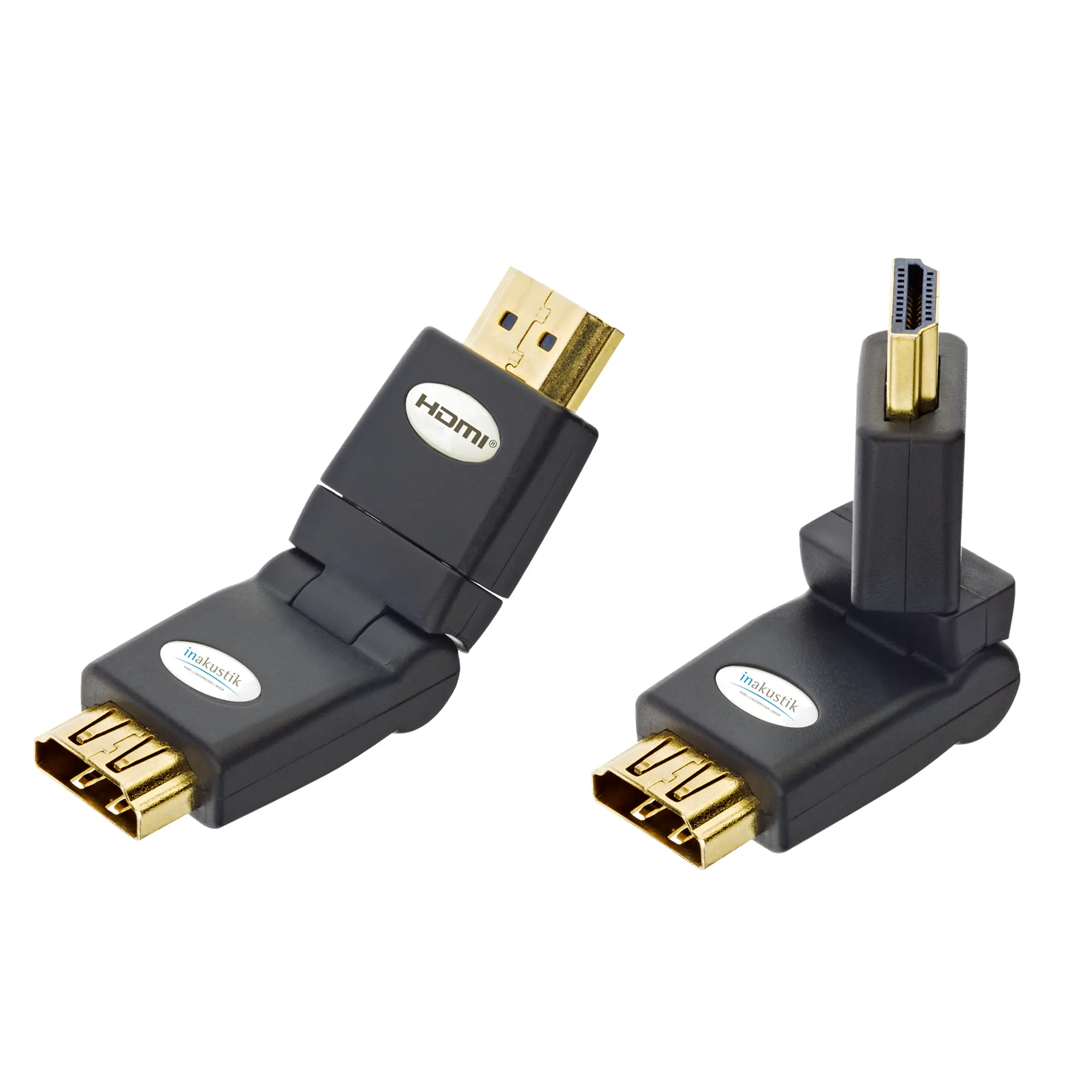

An HDMI angle adapter that can be swiveled in all directions for connection of an HDMI cable at an angle. Ideal for confined spaces behind the LCD, plasma TV etc.

in-akustik hat mit den Exzellenz BFA Bananas eine Anschlussmöglichkeit für Lautsprecherkabel entwickelt, die den strengen Bestimmungen der BFA-Norm (British Federation of Audio) entspricht. Geeignet für Leiterquerschnitte bis 6 mm². Weiß / Schwarz kodiert. Mit Schraubanschluss.
Using this jack adapter, all smartphones, laptops or other devices with a 3.5 mm jack can be easily connected to a mixing console, amplifier, AV receiver or other devices with a 6.3 mm jack socket. It is also suitable for connecting headphones with 3.5 mm jack plugs to hi-fi components with a 6.3 mm jack input.

Solid, gold-plated 3.5 mm stereo jack adapter with two cinch sockets (left & right).

Compact HDMI angle adapter with gold-plated contacts for solving various installation problems.

The Premium doublettes in sandwich design consist of metal disks and special rubber for optimum damping of vibrations between the devices and the locations on which they are standing.


Suitable for cable cross-sections up to 16.0 mm². With screw connection and high-quality, 24k gold-plated contacts. Red/black coded.


Suitable for cable cross-sections up to 6 mm². With soldered connection and high-quality 24k gold-plated contacts. Red/black coded.
For cable cross-sections up to 2.5 mm². With soldered connection and high-quality 24k gold-plated contacts. Red/black coded.


Suitable for cable cross-sections up to 6.0 mm². Complies with the strict provisions of the BFA standard. Red/black coded. With screw connection.

With the Exzellenz BFA bananas, in-akustik has developed a connection option for loudspeaker cables that meets the strict requirements of the BFA standard (British Federation of Audio). Suitable for cable cross-sections up to 10 mm². Red/black coded. With screw connection.

Wireless music enjoyment in the highest quality: With our Audio Bluetooth Receiver, you can wirelessly stream your favorite music to your HiFi system – all in impressive quality. Thanks to aptX® HD support, you'll experience music at a resolution of 48kHz / 24-bit, surpassing CD quality. Whether it's a smartphone, tablet, or laptop – the receiver is brand-independent and compatible with almost all Bluetooth-enabled devices. Top-notch sound processing: The integrated Wolfson Digital Interface Chip ensures precise signal processing. The quartz clock technology minimizes jitter effects, providing clear and detailed sound reproduction – perfect for discerning listeners. Flexibility through versatile connections: The receiver offers maximum flexibility: In addition to an analog 3.5mm output, there is an optical digital output (TOS-Link) available. This allows you to easily connect it to modern amplifiers or active speakers and customize your setup. Convenient usage and extended range: With Bluetooth 5.1, you enjoy stable connections with a range of up to 20 meters (depending on local conditions). The receiver can store up to eight devices and automatically recognizes them, saving you time when reconnecting. Easy pairing with NFC: For even more convenience, the receiver supports NFC. Simply hold your device near the receiver, and the connection will be established automatically – it’s that quick. Technical highlights at a glance: Bluetooth standards: aptX®, aptX® HD, aptX® Low Latency, SBC codec, A2DP Range: Up to 20 meters Outputs: Optical digital output (TOS-Link), analog stereo output (3.5mm) Dynamic range: >95 dB Frequency range: 20 Hz – 20 kHz Compact design for any setup: With its dimensions of just 75.9 x 69.8 x 20.3 mm, the receiver blends discreetly into any HiFi system. Despite its small size, it offers powerful features for an exceptional listening experience. Your gateway to the wireless audio world: Transform your HiFi system into a modern streaming system and experience music with all its details – wirelessly and effortlessly. Whether for daily music enjoyment or demanding listening sessions, the Audio Bluetooth Receiver is your perfect companion. Get inspired

The Exzellenz Bolide shock absorber consists of a special rubber compound and an elaborate lamella design for optimum damping of vibrations between devices and the locations on which they are standing.

High-end and hi-fi systems are a combination of high-precision and filigree devices. Perfectly coordinated, they are capable of reproducing music in outstanding quality. However, in order for the components to work perfectly, they must be kept as free from interference as possible, just like high-precision measuring instruments. The same applies to the connection cables. However, interference can occur in many different ways. In addition to the typical electromagnetic interference, which can be minimized by good shielding, for example, mechanical vibrations and shocks also affect playback quality. The Referenz cable bases have been specially developed for cables. They also have a special gel incorporated in their base and additional natural rubber bands to accommodate the freely suspended cables. As well as absorbing vibrations, the Referenz cable bases also keep the cable at a distance from the floor, reducing unwanted capacitance and the impact on the electronics.

High-end and hi-fi systems are a combination of high-precision and intricately made devices. Perfectly attuned to each other, they allow music to be played back in outstanding quality. To ensure that all components can function flawlessly, they need to be kept free of interference to the greatest extent possible, just like high precision measuring equipment does. The same also applies for the connection cables. Interference is caused in a number of different ways. Along with typical electromagnetic interference, which can, for example, be minimised by using good shielding, mechanical vibrations and shocks also have an impact on the playback quality. Added to this are the effects of capacitive coupling between conductors and floors, which affect loudspeakers cables in particular. The conductors form unwanted capacitance, not just in interplay with each other, but also with other surfaces in the immediate surroundings. A good way to counteract this is by increasing the distance to the surfaces. As a rule, a few centimetres suffice. Vibrations are caused in different ways and they can be transmitted by structure-borne and air-borne noise. Structure-borne noise refers to vibrations that are exhibited by a body, such as the housing of a device. An example of this is the loudspeaker box. The membranes of the speakers are stimulated, making them vibrate. However, as the membranes feature a mechanical connection with the loudspeaker housing, they also transfer vibrations to the housing. The vibrations will be stronger or weaker according to the housing weight and the insulation. The vibrations are also transferred to the surface on which the loudspeakers are placed, this being the floor. Two things now occur. On the one hand, the floor emits some of the structure-borne energy as airborne sound (resulting in the typical droning noise), while on the other hand, the structure-borne noise is transferred, for example, to the cable placed on the floor. More about the effects of this later on. Airborne sound refers to vibrations that are transferred through the air and that are audible for humans (with the exception of infrasound and ultrasound). The primary purpose of a hi-fi system is to produce sound. However, airborne noise not only stimulates the eardrum, but also acts on all other surfaces it reaches. This causes the walls, floors and other surfaces, and ultimately the hi-fi components and cables, to vibrate as well. The combination of airborne and structure-borne noise not only causes glasses in a display case to vibrate mechanically, but all components, including the cable used for a hi-fi signal chain, as well. Experiments have shown that the sound from the components and from the cables is impaired by the vibrations. One reason for this is, for example, the capacity values of components in relation to each other, which constantly change due to the vibrations. In order to minimise these so-called microphonic effects, the components must be isolated from the surface on which they are placed. This can be done by using the Reference High Tech Gel Absorber, for example, for appliances and loudspeakers. Their core contains a special gel, which physically converts the vibrations into heat. The Reference Cable Bases have been developed specifically for cables. Their base also contains a special gel, along with natural rubber strips, in which the cables can float freely. Along with absorbing the vibrations, the Reference Cable Bases also keep the cables at a distance to the floor. This reduces unwanted capacitances and reduces the effects on the electronics.
